library(tidyverse)
library(broom)
library(knitr)
library(patchwork)Lecture 11: Multilevel models
music <- read_csv("data/musicdata.csv") |>
  mutate(orchestra = factor(if_else(instrument == "orchestral instrument",
                                    1, 0)),
         large_ensemble = factor(if_else(perform_type == "Large Ensemble",
                                         1, 0))
  )
Part 1: Univariate EDA
Below are plots of the distribution of the response variable na for (1) individual performances and (2) aggregated by musician (id)
p1 <- ggplot(data = music, aes(x = na)) +
  geom_histogram(color = "white", binwidth = 2) +
  labs(x = "NA",
       title = "Individual performances")

p2 <- music |>
  group_by(id) |>
  summarise(mean_na = mean(na)) |>
  ggplot(aes(x = mean_na)) +
  geom_histogram(color = "white", binwidth = 2) +
  labs(x = "Average NA",
       title = "Aggregated by musician")

p1 + p2 + plot_annotation(title = "Negative affect scores")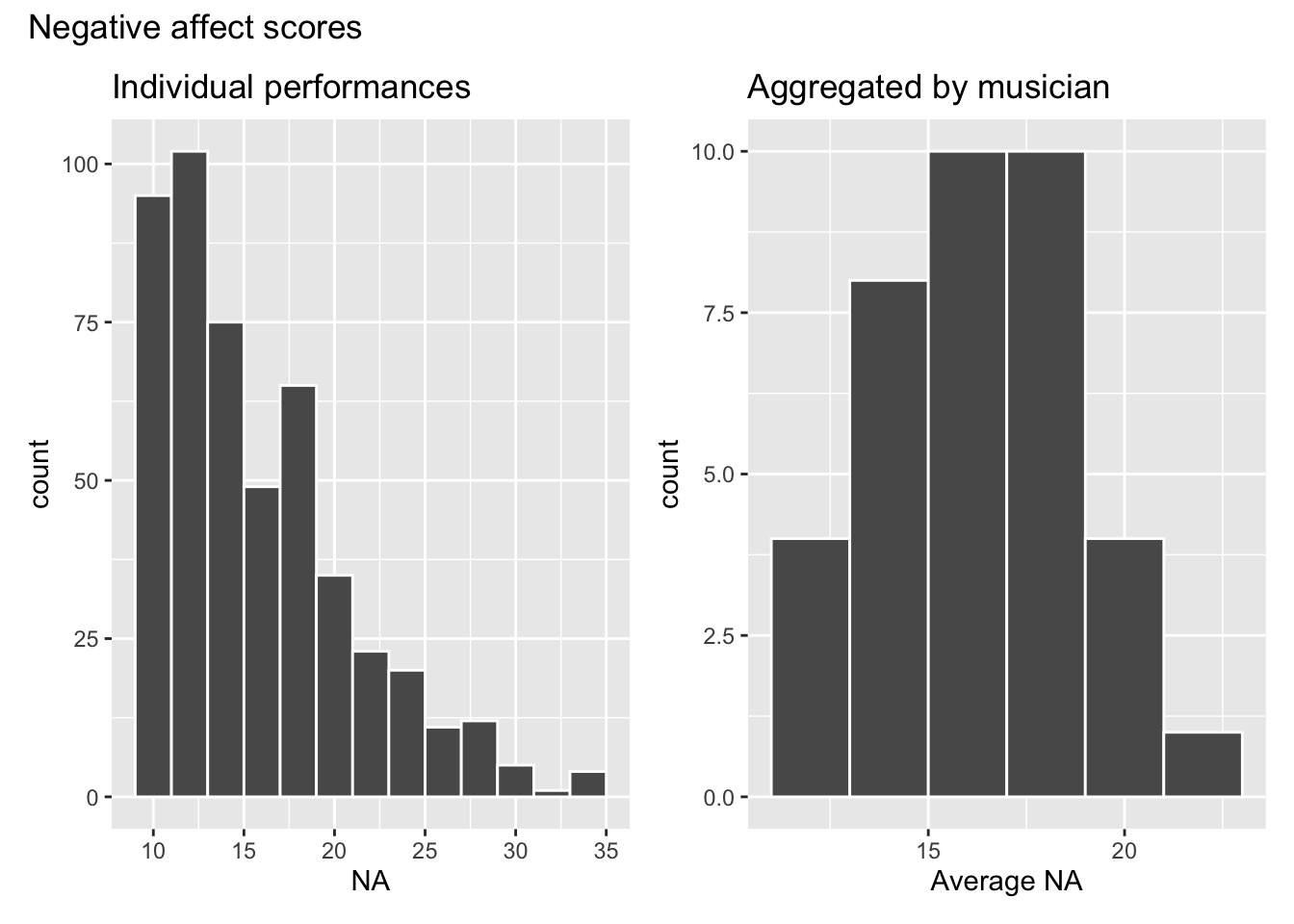
Ex 1
How are the plots similar? How do they differ?
Ex 2
What are some advantages of each plot? What are some disadvantages?
Part 2: Bivariate EDA
Ex 3
Make a single scatterplot of the negative affect versus number of previous performances (previous) using the individual observations. Use geom_smooth() to add a linear regression line to the plot.
# add code
Ex 4
Make a separate scatterplot of negative affect versus number of previous performances (previous) for each musician (id). Use geom_smooth() to add a linear regression line to each plot.
# add code
Ex 5
How are the plots similar? How do they differ?
Ex 6
What are some advantages of each plot? What are some disadvantages?
Part 3: Level One Models
Fit and display the Level One model for musician 22.
music |>
  filter(id == 22) |>
  lm(na ~ large_ensemble, data = _) |>
  tidy() |>
kable(digits = 3)| term | estimate | std.error | statistic | p.value |
|---|---|---|---|---|
| (Intercept) | 24.500 | 1.96 | 12.503 | 0.000 |
| large_ensemble1 | -7.833 | 2.53 | -3.097 | 0.009 |
Fit the Level One models to obtain the fitted slope, intercept, and \(R^2\) value for each musician.
# set up tibble for fitted values
model_stats <- tibble(slopes = rep(NA,37),
               intercepts = rep(NA,37),
               r.squared = rep(NA, 37))

ids <- music |> distinct(id) |> pull()

# fit the model and score the releveant statistcs
for(i in 1:length(ids)){
level_one_data <- music |>
  filter(id == ids[i])

# check if more than one performance type
num_perform_types <- level_one_data |>
  distinct(large_ensemble) |>
  nrow()

if(num_perform_types > 1){
  #if more than one performance type, calculate all model statistics

level_one_model <- lm(na ~ large_ensemble,
                      data = level_one_data)

level_one_model_tidy <- tidy(level_one_model)

model_stats$slopes[i] <- level_one_model_tidy$estimate[2]
model_stats$intercepts[i] <- level_one_model_tidy$estimate[1]
model_stats$r.squared[i] <- glance(level_one_model)$r.squared
}else{
  # if only one performance type, calculate intercept and R^2
  model_stats$intercepts[i] <- mean(level_one_data$na)
  model_stats$r.squared[i] <- 0
}
}
Plot the estimated intercepts, slopes and, \(R^2\) values.
level_one_int <- ggplot(model_stats, aes(x = intercepts)) +
  geom_histogram(color = "white", binwidth = 2) +
  labs(x = "",
       title = "Fitted intercepts",
       subtitle = "for 37 musicians")

level_one_slope <- ggplot(model_stats, aes(x = slopes)) +
  geom_histogram(color = "white", binwidth = 2) +
  labs(x = "",
       title = "Fitted slopes",
       subtitle = "for 37 musicians")

level_one_int + level_one_slope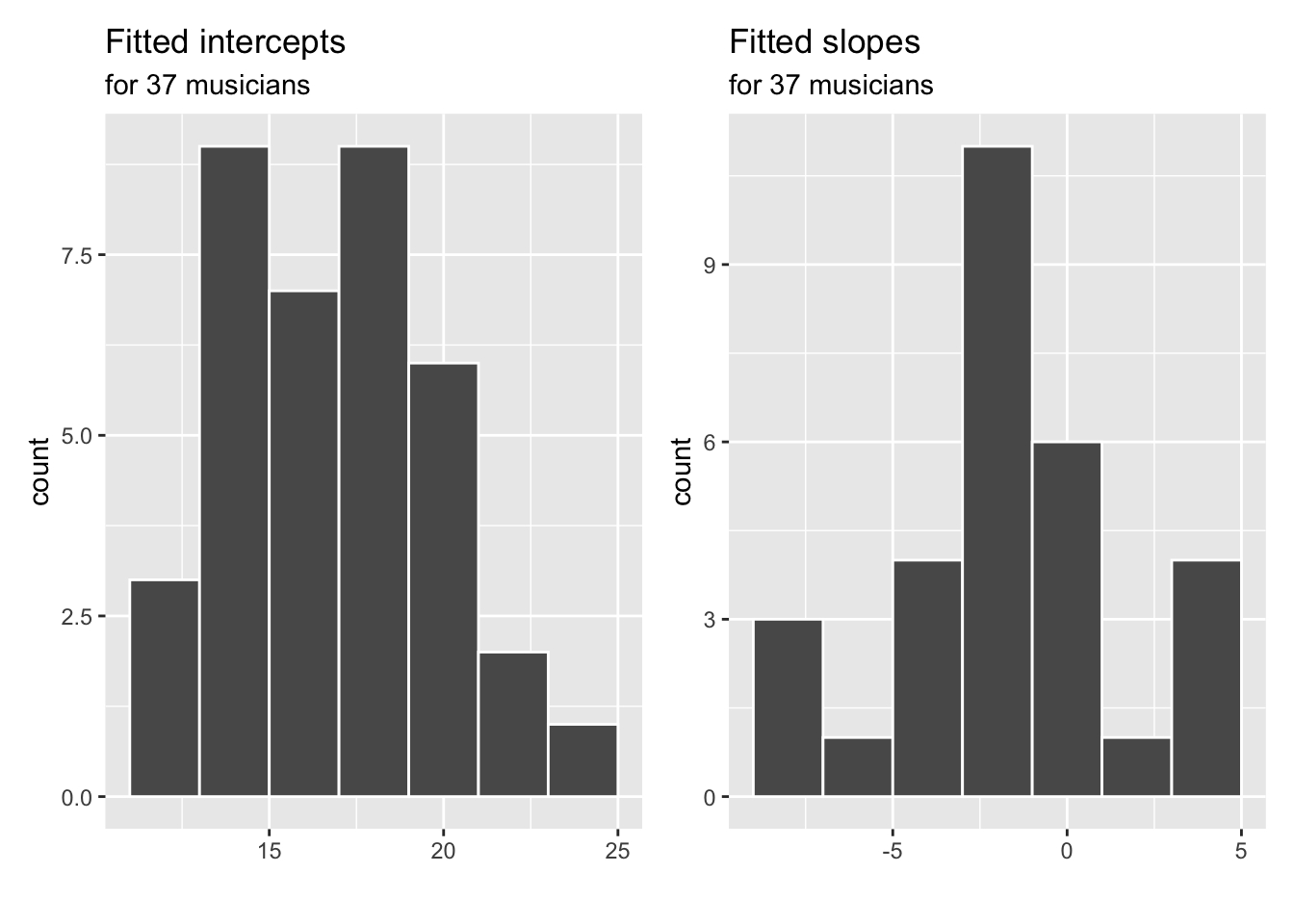
ggplot(model_stats, aes(x = r.squared)) +
  geom_histogram(color = "white", binwidth = 0.05) +
  labs(x = "",
       title = "Fitted R-squared values",
       subtitle = "for 37 musicians")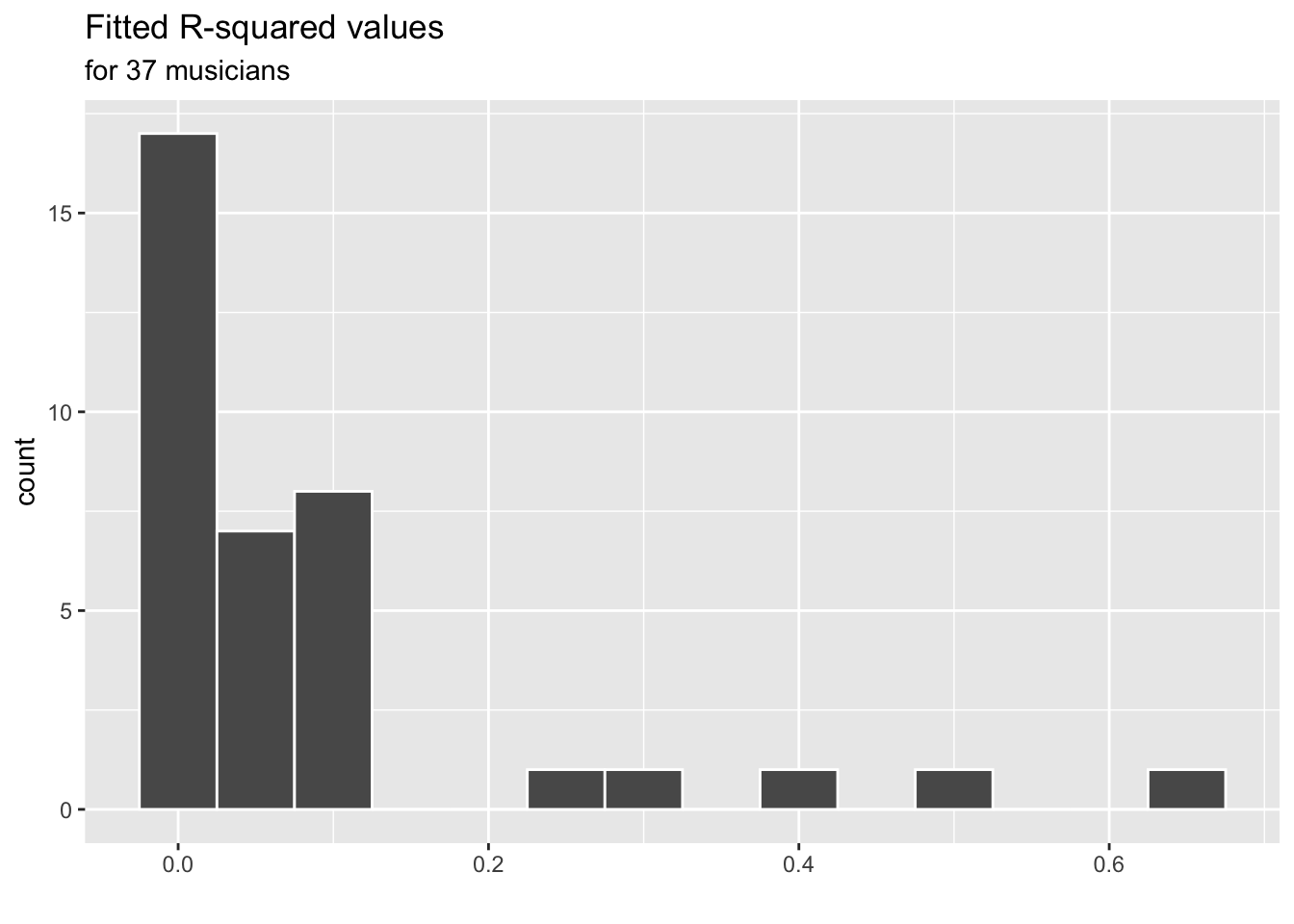
Part 4: Level Two Models
# Make a Level Two data set
musicians <- music |>
  distinct(id, orchestra) |>
  bind_cols(model_stats)
Model for intercepts
a <- lm(intercepts ~ orchestra, data = musicians)
tidy(a) |>
kable(digits = 3)| term | estimate | std.error | statistic | p.value |
|---|---|---|---|---|
| (Intercept) | 16.283 | 0.671 | 24.249 | 0.000 |
| orchestra1 | 1.411 | 0.991 | 1.424 | 0.163 |
Model for slopes
b <- lm(slopes ~ orchestra, data = musicians)
tidy(b) |>
kable(digits = 3)| term | estimate | std.error | statistic | p.value |
|---|---|---|---|---|
| (Intercept) | -0.771 | 0.851 | -0.906 | 0.373 |
| orchestra1 | -1.406 | 1.203 | -1.168 | 0.253 |